Posts

Showing posts with the label Environment

From Debugging to Optimization: Unlock the Power of Plugin Trace Logs

Image
In the world of Dynamics 365 CRM and the Power Platform, plugins are powerful tools that allow you to execute custom business logic during system events. But with great power comes great responsibility — especially when things go wrong. This is where Plugin Trace Logs come in. Whether you're debugging an issue or optimizing performance, Plugin Trace Logs provide deep insights into your plugin’s behavior, execution path, and errors. Let’s dive into how you can harness this often-overlooked feature to your advantage. What Are Plugin Trace Logs? Plugin Trace Logs are diagnostic tools built into Dynamics 365 that allow developers and architects to trace what a plugin is doing when it runs — including: Input and output parameters Execution pipeline stages Exception messages Performance metrics Custom trace messages (via `TracingService`) These logs help isolate issues, validate logic, and fine-tune execution time. How to Enable Plugin Trace Logs To start using Plugin Trace Logs, you’ll ...
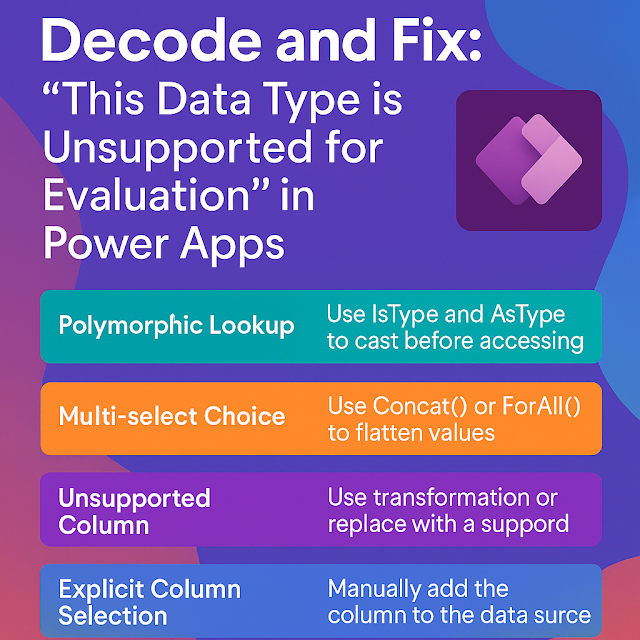
Decode and Fix: “This Data Type is Unsupported for Evaluation” in Power Apps

Image
 One common frustration when building Canvas Apps over Dataverse is encountering this cryptic error:  “This data type is unsupported for evaluation” This message typically appears when Power Apps cannot process or render a specific Dataverse column type within a control or formula. While it may seem vague, it’s usually tied to specific patterns involving complex column types or runtime data structure mismatches. In this blog, we'll explore common causes, scenarios, and practical fixes from both a developer and architectural standpoint. Root Causes of the Error 1. Polymorphic Lookups Dataverse supports polymorphic relationships (e.g., `Owner`, `Customer`, `Regarding`) that can point to multiple entity types. These lookups can't be directly evaluated in Power Apps unless you cast the reference explicitly. Use: If(     IsType(ThisItem.Customer, Account),     AsType(ThisItem.Customer, Account).Name,     AsType(ThisItem.Customer, Contact).FullName ) 2....

Why Environment Management Matters for Architects and Developers in Power Platform

Image
Environment Management isn’t just an admin feature—it’s a strategic enabler for solution architects and developers building on Power Platform. Here's why it plays a vital role for both roles: For Solution Architects 1. Design with Governance in Mind Architects can align app and automation design with environment strategies like Dev/Test/Prod separation, data boundary policies, and compliance zones—ensuring scalability, security, and regulatory alignment from day one. 2. Environment Strategy as Architecture Backbone Environment Management allows architects to define:  Region-specific environments for data residency  Dedicated environments for critical workloads  ALM pipelines with clear environment stages  This supports a robust and modular enterprise architecture. 3. Visibility into the Platform Ecosystem With full visibility and telemetry, architects can understand: How environments are used Where capacity is strained Which apps or flows might need restructuring Thi...